Understanding Encryption Standards
Encryption is the foundation of VPN security, transforming readable data into an unreadable format that can only be decoded with the correct decryption key. When you connect to a VPN, your data is encrypted using sophisticated algorithms before it ever leaves your device. The gold standard in the industry is AES-256 (Advanced Encryption Standard with 256-bit keys), which offers 2^256 possible key combinations. To put this in perspective, brute-forcing AES-256 with current technology would require more energy than exists in the solar system.
VPN Protocols Compared
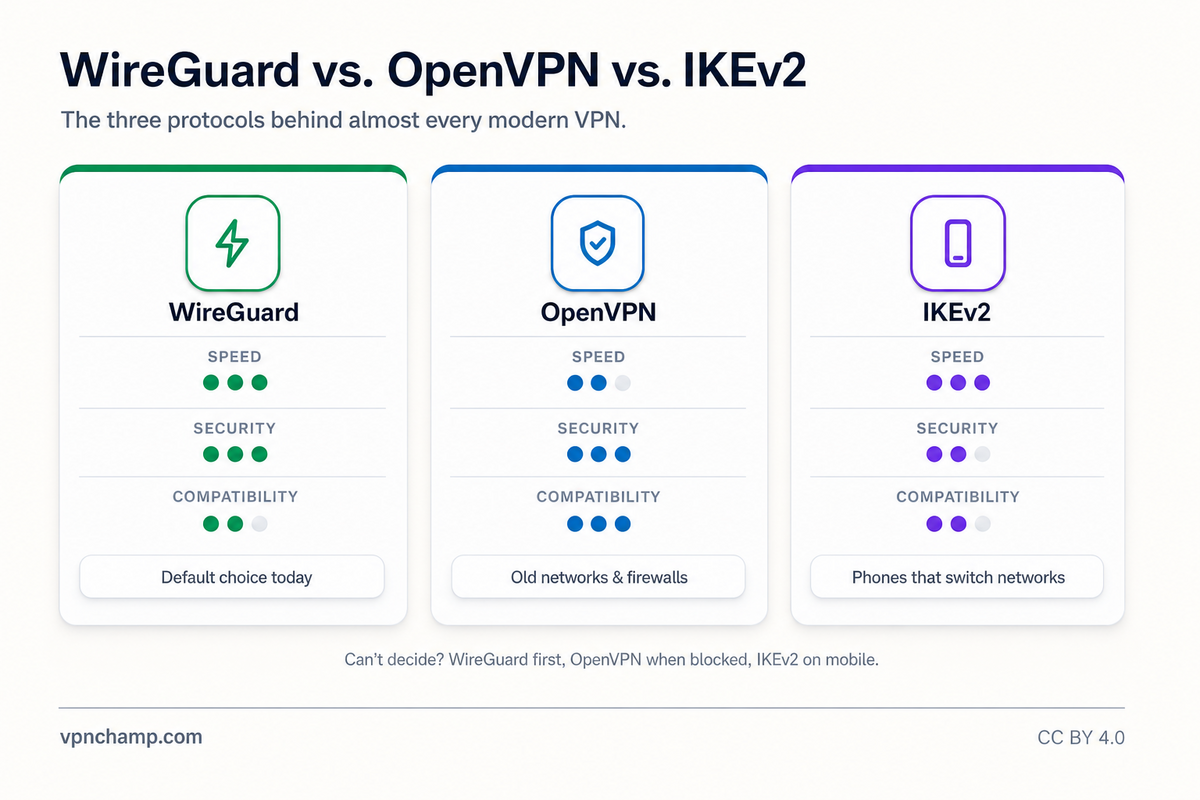
VPN protocols determine how the encrypted tunnel between your device and the VPN server is established and maintained. Each protocol offers different trade-offs between speed, security, and compatibility. The most common protocols in use today are OpenVPN, WireGuard, IKEv2/IPSec, and L2TP/IPSec. Some providers also offer proprietary protocols like NordLynx (built on WireGuard) or Lightway (developed by ExpressVPN) that are optimized for their specific infrastructure.
OpenVPN: The Industry Standard
OpenVPN has been the industry standard for over two decades. It is an open-source protocol that has been extensively audited by security researchers worldwide. OpenVPN supports both UDP (faster, better for streaming) and TCP (more reliable, better for restricted networks) transport modes. Its open-source nature means vulnerabilities are quickly identified and patched by the community. While OpenVPN is not the fastest protocol available, its proven security track record and flexibility make it a trusted choice for privacy-focused users.
WireGuard: The Modern Alternative
WireGuard is a newer protocol that has rapidly gained adoption due to its lean codebase (roughly 4,000 lines of code compared to OpenVPN's 70,000+), making it easier to audit and less susceptible to bugs. WireGuard uses state-of-the-art cryptographic primitives including ChaCha20 for encryption, Poly1305 for authentication, and Curve25519 for key exchange. In practice, WireGuard delivers significantly faster connection times and higher throughput than OpenVPN, often with less battery drain on mobile devices.
Choosing the Right Protocol
IKEv2/IPSec is particularly well-suited for mobile devices because of its MOBIKE support, which allows seamless switching between Wi-Fi and cellular networks without dropping the VPN connection. It offers strong security and good speeds, though its closed-source nature on some platforms limits independent verification. L2TP/IPSec is an older protocol that is generally considered secure but slower; it is mainly used as a fallback when other protocols are unavailable.
When choosing a protocol, consider your priorities. For maximum security with proven reliability, OpenVPN remains excellent. For the best speed and modern cryptography, WireGuard is the top choice. For mobile devices that frequently switch networks, IKEv2 is ideal. Most quality VPN apps let you switch protocols easily, so you can experiment to find the best balance of speed and security for your specific situation and network conditions.